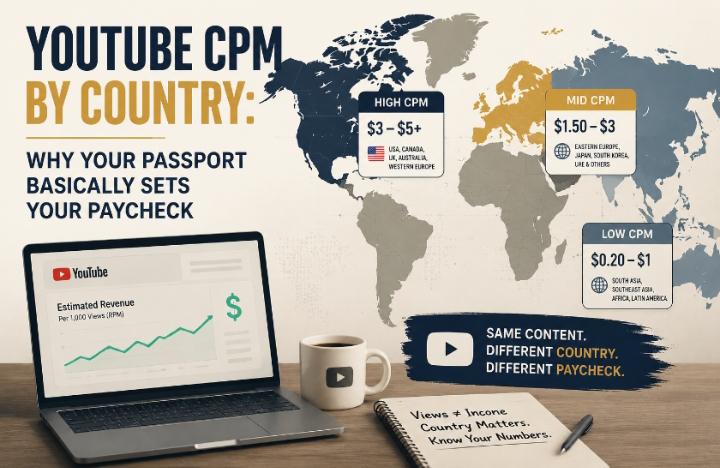
YouTube CPM by Country: Why Your Passport Basically Sets Your Paycheck
Comment I actually received under one of my videos: “Bro your content is way better than [other creator], why is he richer than you???” He wasn’t richer because his content was better. He was richer because his subscribers lived somewhere different than mine.
That comment stuck with me for a long time, partly because I didn’t have a good answer for it at the moment, and partly because I genuinely didn’t understand the real reason myself yet. The creator in question and I made almost identical content in the same niche, posted at a similar frequency, and had comparable view counts. But he was consistently earning two to three times what I was, month after month. It took some actual digging — and a slightly embarrassing conversation where I finally just asked him directly — to learn the real answer: his audience was overwhelmingly American, and mine was overwhelmingly not.
The Tool This Article Is Built Around
Before we go further, if you want to see this play out with your own numbers rather than someone else’s story, plug your monthly views into the YouTube Money Calculator and try switching the country dropdown between a few different options. Watching the estimated monthly total shift by hundreds or thousands of dollars just from changing that one field is the fastest way to actually feel what this article is explaining.
Why Advertisers Pay Different Amounts for Different Countries
Here’s the plain-English version of something that sounds complicated but really isn’t. Every time your video plays an ad, YouTube runs a tiny, instant auction among advertisers who want to reach that specific viewer. A car insurance company doesn’t want to reach absolutely everyone equally — they want to reach people who are statistically likely to actually buy car insurance, which usually means people in countries with higher average incomes, more car ownership, and more competitive insurance markets. So they bid more to reach a viewer in, say, Toronto than they would to reach a viewer somewhere with a much smaller insurance market. Multiply that pattern across every industry — software, finance, retail, travel — and you get wildly different CPMs depending purely on where the eyeballs are, regardless of how good the content is.
This is genuinely not a reflection of content quality, effort, or talent. I want to say that plainly because I’ve seen too many creators, myself included at one point, internalize a low RPM as some kind of verdict on whether their content is “good enough.” It isn’t. It’s an accident of economics that has nothing to do with your creativity.
A Rough Map of Where the Money Actually Is
Without pretending these numbers are exact — they shift constantly with ad demand — here’s roughly how the world breaks down by tier. At the top sit countries like the United States, Switzerland, the United Kingdom, Australia, Canada, and much of Western and Northern Europe, where RPMs commonly land anywhere from $3 to $5 or higher depending on niche. In the middle tier, you’ll find countries across Southern and Eastern Europe, parts of East Asia like Japan and South Korea, and Gulf countries like the UAE, typically producing RPMs somewhere in the $1.50 to $3 range. At the lower end sit much of South Asia, Southeast Asia, Africa, and Latin America, where RPMs often fall between $0.20 and $1, simply because ad markets there are younger and advertiser budgets are smaller relative to audience size.
None of this is fixed forever, either. Ad markets mature over time as more advertisers enter a region and start competing for attention, which is one reason it’s worth rechecking your numbers every so often rather than assuming today’s tier is permanent.
🌍 Real talk: A channel with 80% of its audience in a lower-CPM region and 20% in a top-tier region will often see its overall RPM pulled disproportionately toward that smaller high-value slice — which is exactly why checking your actual audience breakdown, not just guessing, matters.
The Mistake I Made Trying to “Fix” My Geography
Once I understood the country gap, I did something a little desperate. I started deliberately inserting American cultural references into videos that had nothing to do with them, mentioning US cities and holidays that weren’t relevant to my actual content, convinced I could somehow trick the algorithm into serving my videos to more American viewers. It didn’t work — not even a little. My retention actually dropped, because my existing audience found the random references confusing and out of place, and my overall performance suffered for a few weeks before I reversed course.
What I eventually learned is that YouTube’s recommendation system serves your content primarily to people who are actually likely to watch and engage with it, largely based on your existing audience’s behavior and your content’s actual subject matter — not based on scattered keyword bait aimed at a country you’re hoping to attract. You can’t really force your way into a different geography. What you can do is make deliberate content and language choices that naturally appeal to a broader or more specific audience, and let the results follow honestly instead of trying to game a system that’s better at spotting inauthenticity than most creators expect.
What Actually Worked Instead
After abandoning the fake-references approach, I tried something far less clever and far more effective: I simply started making content in clear, accessible English without leaning too heavily on region-specific slang, and I picked topics with genuinely universal appeal rather than hyper-local ones. Over about a year, my audience gradually broadened without me forcing anything, and my RPM crept up modestly as a natural side effect — not dramatically, but honestly, which felt a lot better than the fake version ever did.
The bigger shift, honestly, was mental rather than strategic. I stopped treating my audience’s geography as a problem to solve and started treating it as a fact to plan around. That reframing led me toward brand deals and sponsorships specifically targeted at my actual audience’s region, which turned out to be far more lucrative than chasing a higher-CPM country I was never going to authentically capture anyway.
You can’t out-hustle geography. You can only build a strategy that’s honest about where your audience actually is.
A Story About a Market That Changed Underneath a Creator
A creator I’ve followed for years builds tech review content aimed at a Southeast Asian audience. For a long time, roughly four years, his RPM sat frustratingly flat in a fairly low tier despite steadily growing his subscriber base and watch time. He mentioned once in a community post that he’d basically made peace with it, assuming that tier was just permanently attached to his region and there wasn’t much to be done beyond diversifying into sponsorships, which he leaned into heavily.
Then, without him changing anything about his content strategy at all, his RPM began climbing noticeably over about eighteen months — not dramatically, but consistently, month over month. The explanation wasn’t anything he did. E-commerce and tech advertising had matured significantly in his region during that window, with more international brands entering the market and competing harder for the exact audience he’d been building for years. He’d essentially been standing still while the ground underneath him slowly rose. By the time he noticed the pattern clearly enough to mention it publicly, his ad revenue alone had roughly tripled from where it sat during that flat stretch.
The lesson I took from watching that unfold from the outside is that today’s CPM tier for your region isn’t a life sentence. Ad markets genuinely do mature over time, sometimes faster than anyone tracking them expects, and a region that looks unpromising this year can look meaningfully different in two or three years without you having to do anything differently at all. That’s not a reason to stop diversifying your income — his sponsorship-heavy strategy was smart regardless — but it is a reason not to treat a current low RPM as a permanent ceiling.
Country CPM Isn’t the Only Geography That Matters
One nuance that surprised me once I started paying closer attention: CPM can vary meaningfully even within a single country, not just between countries. Advertisers in the United States, for instance, often bid differently to reach viewers in major metropolitan areas with higher average incomes versus more rural regions, and certain US states carry more advertiser competition in specific industries like real estate or legal services than others. This level of detail isn’t something a general calculator can capture precisely, but it’s worth knowing that “American audience” isn’t quite as uniform a category as it sounds, even though it still sits comfortably in the top CPM tier overall.
If Most of Your Audience Is in a Lower-CPM Region
This is not a dead end, and I want to be direct about that, because a lot of creators in this position quietly give up on monetization entirely, which is a genuine shame. Ad revenue is only one income stream, and often not the most important one for creators with a strong regional audience. Sponsorships from local and regional brands, digital products priced appropriately for your audience’s actual purchasing power, and platforms like TikTok’s Creator Rewards or Facebook’s Content Monetization — which have their own separate country availability and payout structures — can meaningfully outperform YouTube ad revenue for exactly this kind of audience.
It’s worth running the same content through our TikTok Earnings Calculator and Facebook Content Monetization Calculator to see whether one of those platforms treats your specific audience geography more favorably than YouTube does — the answer genuinely varies by region and isn’t the same for everyone.
A Practical Way to Check Your Own Number
Open YouTube Studio, go to Audience, and look at your top five countries by watch time — not by view count alone, since watch time is a better reflection of your genuinely engaged audience. Take note of the rough percentage split, then run your monthly views through the calculator above using your top country first, and again using your second-most-common country, to see the realistic range you’re actually working within rather than a single misleading average.
This exercise alone would have saved me that awkward comment-section moment years ago. I’d have known, instantly and with actual numbers, exactly why that other creator was earning more — and I could have spent that energy on something more useful than wondering if my content simply wasn’t good enough.
Worth doing this check roughly once a quarter rather than once and forgetting about it, too. Audience geography drifts over time as your content evolves, as certain videos get picked up by international viewers unexpectedly, or as your channel’s tone shifts subtly in ways that appeal more or less to different regions. A country breakdown that was accurate a year ago might already be meaningfully out of date, and re-running the numbers periodically keeps your expectations grounded in your current reality instead of an outdated snapshot.
Rounding Out the Picture
Once your title is pulling in the right kind of attention, a sharper, better-scored option from our YouTube Title Generator costs nothing and takes seconds to try. And if comedic, skit-style content for a Nigerian audience is part of your content plan, our TikTok skit scripts for Nigerian students in school pair naturally with the geography-first thinking this whole article has been about — building deliberately for the audience you actually have, rather than one you wish you had.
Looking back at that comment-section moment now, I wish I’d had a calculator like this one back then instead of stewing over it for weeks. Geography explains far more of the gap between two similar creators than most people assume, and once you actually see the numbers side by side instead of guessing, the whole comparison stops feeling personal. It’s just math — math you can plan around instead of taking personally.
Scroll back up, switch the country dropdown a few times, and see for yourself exactly how much geography actually changes the number.
