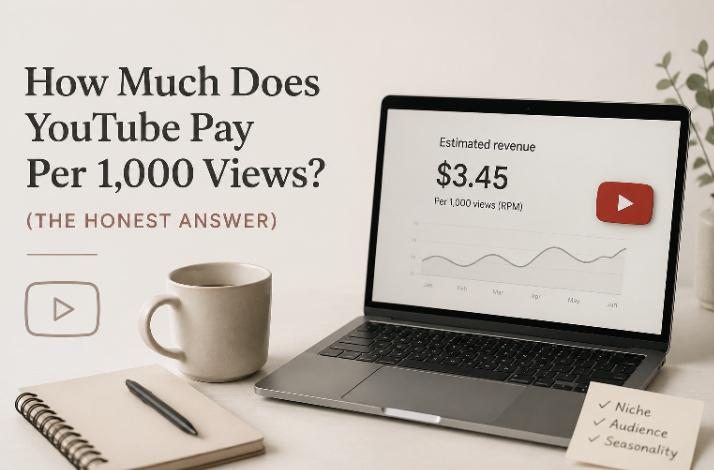
How Much Does YouTube Pay Per 1,000 Views? (The Honest Answer)
I still remember the exact moment I opened my first AdSense payment and felt my stomach drop. My video had done 220,000 views — a number that felt enormous to me at the time — and I was already mentally spending the money on a new microphone. When the number finally loaded, it read $94. I actually refreshed the page twice because I thought it hadn’t loaded properly. Ninety-four dollars. For 220,000 views. I sat there doing the math over and over, convinced YouTube had made a mistake, before slowly realizing I was the one who’d made the mistake — I’d believed a number I saw in a random comment section instead of actually learning how this system works.
That comment, if you’re curious, said “YouTube pays $5 per 1,000 views.” Someone had typed it with total confidence, dozens of people had liked it, and I’d taken it as gospel without questioning it once. It took me an embarrassingly long time to understand that this single number doesn’t exist — not really — and that whoever wrote that comment was either talking about a completely different niche, a completely different audience, or was simply guessing.
The short, honest answer: YouTube typically pays somewhere between $2 and $12 per 1,000 monetized views, depending heavily on your audience’s country, your content niche, and the season. There is no single flat rate — anyone who tells you otherwise is guessing.
Why “YouTube Pays $X Per 1,000 Views” Is the Wrong Question
Here’s what I wish someone had told me before I ever uploaded a video: YouTube doesn’t pay a flat rate per view. It runs an actual ad auction, in real time, for every single ad impression, and advertisers bid different amounts depending on who’s watching, where they’re watching from, and what kind of content they’re watching. A skincare brand might bid aggressively to reach someone in London watching a beauty tutorial. That same brand might bid almost nothing to reach someone in a country where they don’t sell products at all. Multiply that pattern across millions of advertisers and billions of daily views, and you start to see why one flat number was always going to be a myth.
What actually exists are two real numbers worth knowing: CPM, which is what advertisers pay per 1,000 ad impressions, and RPM, which is what you as the creator actually take home per 1,000 views after YouTube’s cut and after accounting for views that weren’t monetized at all. RPM is always lower than CPM, sometimes by a lot, and RPM is the number that actually lands in your bank account — so it’s the one worth paying attention to.
A Real Example: Two Creators, Same Views, Very Different Checks
A friend of mine runs a personal finance channel aimed squarely at a US audience — budgeting tips, investing basics, that kind of thing. Another creator I follow online runs a general comedy sketch channel with viewers scattered across dozens of countries. Both of their channels crossed 500,000 monthly views around the same month, and both messaged me separately, genuinely curious what the other might be earning.
The finance creator’s RPM landed around $9 — finance content attracts serious advertiser competition, and his audience skewed heavily American. His 500,000 views translated to roughly $4,500 that month. The comedy creator’s RPM landed closer to $1.80, since comedy draws lower-value ad competition and his audience was spread across many lower-CPM regions. His same 500,000 views brought in closer to $900. Same platform, same view count, same upload consistency — a five-times difference in actual income, entirely explained by niche and geography.
Neither of them was doing anything wrong. That’s the part that took me the longest to accept — there wasn’t a mistake to fix in the comedy creator’s case, just a different economic reality attached to a different kind of content and audience. Once he understood that, he stopped comparing himself to the finance channel entirely and started focusing on brand deals instead, where his broad international audience was actually an advantage rather than a disadvantage.
YouTube Money Calculator
Estimate your YouTube ad revenue by monthly views and country.
These figures are estimates based on average industry CPM/RPM data. Actual YouTube earnings depend on your niche, audience location, seasonality, ad demand, and YouTube's revenue share, and can vary significantly.
If you want to stop guessing and see where your own channel actually lands, plug your monthly views and audience country into our YouTube Money Calculator above. It uses real RPM data across more than 80 countries instead of one flattened global number, which is exactly the mistake I made reading that comment years ago.
What Actually Moves Your RPM Up or Down
A handful of factors do most of the heavy lifting here, and understanding them changed how I plan content entirely. Your niche matters enormously — finance, technology, business, and insurance-adjacent topics attract advertisers willing to pay a premium, while general entertainment, gaming, and reaction content tend to sit on the lower end, simply because fewer advertisers are bidding aggressively for that audience. Your audience’s country matters just as much, since advertisers pay more to reach viewers with higher purchasing power — a channel with a US, UK, or Australian audience will almost always out-earn an identical channel with a broader global audience.
Seasonality plays a bigger role than most new creators expect too. Ad demand climbs heading into the fourth quarter as brands spend down their annual budgets before the holidays, and it noticeably dips every January as those same budgets reset. I panicked the first time I saw a January drop, assuming something had gone wrong with my channel, before realizing it happens to nearly every creator, every single year, like clockwork.
Shorts vs Long-Form: A Mistake I Made for Six Months
Here’s my second confession. For about six months, I leaned almost entirely into Shorts because they were racking up views far faster than my long-form videos ever had. I assumed more views simply meant more money, in a straight line, no exceptions. My monthly view count tripled. My earnings barely moved.
It turns out Shorts revenue comes from a completely separate ad pool that gets divided differently than long-form ad revenue, and it typically produces a noticeably lower RPM per view. I wasn’t doing anything wrong exactly, but I was optimizing for the wrong number. Once I shifted back toward a mix that included more long-form video — content that could actually carry mid-roll ads — my view count dropped by about a third, and my monthly earnings nearly doubled. That was a genuinely humbling lesson in the difference between reach and revenue.
More views felt like more success. It took me half a year to learn that more views and more money are related, but they are not the same thing.
The Second Story: What Happened When I Actually Changed Niches
A year or so after the Shorts mistake, I made a much bigger bet. My channel had started as general life-hack content — cheap, fast-to-produce, decent views, unremarkable earnings. I’d been quietly learning about budgeting and investing on the side for my own life, and on a whim I made one video breaking down how compound interest actually works, using a whiteboard and my phone camera. It did worse in views than my usual uploads. It did dramatically better in revenue.
That one data point nagged at me for weeks. I ran the numbers properly instead of just going on a gut feeling, and the gap was real: my life-hack content was pulling an RPM around $1.40, while that single finance video had pulled closer to $6.20 despite fewer total views. I made the uncomfortable decision to pivot the channel almost entirely toward personal finance content over the following few months, which meant slower growth at first while I rebuilt an audience around a new topic. Six months later, my monthly views were actually lower than they’d been at the peak of the life-hack era — but my monthly earnings were more than double what they’d ever been. I’d spent over a year chasing the wrong metric without realizing it.
I’m not suggesting everyone should abandon their niche and become a finance creator — that would be terrible advice, and most of that pivot only worked because I already had a genuine interest in the topic and could speak to it credibly. What I am suggesting is that it’s worth actually checking your RPM by content type before assuming your highest-view videos are automatically your most valuable ones. Sometimes they’re not, and you won’t know until you look.
A Quick Gut-Check Before You Panic Over a Low Payout
If you’ve just seen a payout that felt disappointing, run through this short list before assuming something’s broken. First, check whether the views came mostly from Shorts, which carry a structurally lower RPM than long-form video — that alone explains a huge percentage of “why is my payout so low” moments I hear about from other creators. Second, check your audience geography in YouTube Studio under Audience, since a sudden shift toward lower-CPM regions can drag your average down even with identical view counts. Third, check the calendar — if it’s January, February, or the days right after a major holiday, ad demand is simply lower industry-wide, and it will recover.
Only after ruling those three out is it worth digging into anything more concerning, like a demonetization flag on a specific video or a change in your content that might be attracting a different, lower-value advertiser category. Most of the time, the explanation is one of the boring three, not something dramatic.
So What Should You Actually Expect?
If you’re just starting out and unsure what’s realistic, here’s a rough, honest range based on my own channel and conversations with dozens of other creators over the years. A general entertainment channel with a mixed global audience might see an RPM between $1 and $3. A channel with a solid US or UK audience in a mid-value niche might see $4 to $7. A finance, business, or software-focused channel with a strong Western audience can realistically see $8 to $15 or occasionally higher. These aren’t promises — they’re a starting point for setting expectations that won’t set you up for the same disappointment I felt staring at that $94 payout.
The single best thing you can do instead of trusting a comment section number is to run your own actual numbers. Pull your monthly views and your audience’s top country from YouTube Studio, plug them into the calculator above, and you’ll get a number grounded in your reality instead of someone else’s guess — or someone else’s flex.
Where to Go From Here
Once you know your real number, a few next steps tend to help the most. If a chunk of your content is going out as short-form video across platforms, it’s worth checking what that same content is earning on TikTok and Facebook too, since RPM differs meaningfully across all three. And before your next upload, a sharper, better-scored title from our YouTube Title Generator costs nothing and takes seconds, but it’s one of the few things you control directly that actually moves the needle on views in the first place.
If you’re building skit-style comedy content for a Nigerian audience specifically, our roundup of TikTok skit scripts for Nigerian students in school is worth a look too — that content style tends to travel well across platforms, and knowing your realistic RPM range in advance means you won’t fall into the same trap I did, chasing raw views instead of the number that actually pays your bills.
Looking back, the $94 payout that once felt like a punch in the stomach turned out to be the best thing that could have happened to me as a creator. It forced me to actually understand a system I’d been guessing about for months, and every decision I’ve made since then — the niche pivot, rebalancing away from Shorts, paying attention to audience geography — traces back to that one uncomfortable number. If a low payout is what got you reading this article, treat it the same way: not as proof you’re failing, but as the exact nudge that gets you paying attention to numbers that actually matter.
Stop guessing your YouTube income from a comment section. Scroll up, plug in your real numbers, and see exactly where you actually stand.
