YouTube Monetization Requirements: My Rejection, My Fix, and What You Actually Need
The first time I applied for the YouTube Partner Program, I got rejected. Not a soft “come back later” — an actual rejection email, citing “reused content,” which stung considerably more than a simple “not enough subscribers yet” would have. I’d been repurposing short clips from my own longer videos into shorter uploads, which felt like completely reasonable content strategy to me at the time. YouTube’s review team saw it differently, and they weren’t wrong to. I just didn’t understand the rules I was breaking.
This article is the roadmap I wish I’d had before that first rejection — laid out as an actual step-by-step journey, not a dry bullet list, because that’s genuinely how it felt to go through it. Every requirement below is real and current, but I’ve tried to explain the “why” behind each one too, since understanding the reasoning made the whole process feel far less arbitrary than it did the first time around.
Once you’re actually monetized, our YouTube Money Calculator above will show you roughly what your views could translate to — worth bookmarking for the day you clear these requirements.
The Roadmap: Five Steps From Zero to Monetized
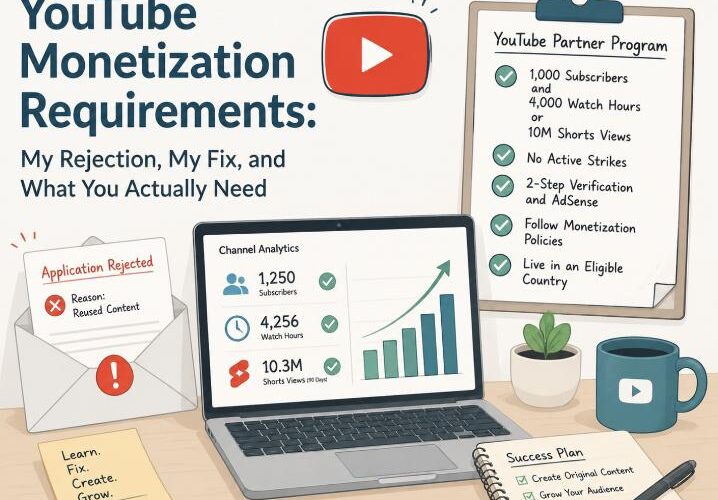
Hit the subscriber and watch-time (or Shorts views) threshold
You need 1,000 subscribers, plus either 4,000 valid public watch hours in the trailing 12 months or 10 million valid public Shorts views in the trailing 90 days. Most creators clear this through steady long-form content, but the Shorts pathway genuinely works too if that’s your format.
Have a clean Community Guidelines record
No active Community Guidelines strikes on your channel at the time of review. If you’ve received a strike previously, it needs to have expired, which typically takes 90 days from issue if it’s your only one.
Turn on 2-Step Verification and link an AdSense account
This is a security requirement, not a creative one, but it trips people up because it’s easy to forget until you’re already at the application step. Set it up early so it’s not the thing delaying your submission.
Follow YouTube’s monetization policies — this is where I got rejected
Your content needs to be original enough, and not simply reused or repurposed from other creators, or even too heavily repurposed from your own existing content without meaningful new value added. This is the step worth understanding properly before you apply, since it’s the one most likely to produce a confusing rejection if you get it wrong.
Live in a country where the program is available
The YouTube Partner Program is available in over 100 countries now, covering the large majority of creators reading this, but it’s worth double-checking your specific country’s current status in YouTube’s official help documentation rather than assuming.
The Watch-Hours Grind Nobody Warns You About
Getting to 1,000 subscribers felt achievable once I actually committed to a consistent schedule — steady, if slow, progress I could see week to week. The 4,000 watch-hour requirement was a completely different kind of challenge, and it caught me off guard. Subscribers accumulate one at a time and feel like visible progress. Watch hours accumulate invisibly across your entire catalog, and for months it felt like I had no idea whether I was actually getting closer or not.
What actually worked was checking my cumulative watch hours in YouTube Studio’s Analytics tab weekly instead of guessing, and specifically noticing which of my videos were contributing the most. It turned out two older videos, ones I’d almost forgotten about, were quietly responsible for a disproportionate share of my total watch hours because they had unusually strong retention compared to my average upload. Once I noticed that pattern, I made two more videos in a similar style and format, and my watch-hour total accelerated noticeably faster than it had been climbing before. The lesson wasn’t “upload more” — it was “figure out what’s actually working and do more of specifically that,” which is a theme that shows up constantly once you start actually reading your own analytics instead of guessing.
Shorts-Only Creators: A Faster, Different Path
If your channel is built entirely around Shorts, the 10-million-views-in-90-days pathway can genuinely move faster than the traditional watch-hour route, especially for content with strong viral potential. A creator I know pivoted almost entirely to Shorts specifically to chase this threshold after struggling to build watch hours through long-form content, and cleared it in just under two months once a handful of videos gained real traction.
The tradeoff worth knowing about upfront: Shorts-heavy channels that clear this threshold quickly sometimes find their actual ad revenue underwhelming once monetized, since Shorts revenue comes from a separate, generally lower-RPM ad pool compared to long-form video. Clearing the threshold fast through Shorts is a completely valid strategy, but it’s worth planning to add some long-form content into your mix once you’re monetized, specifically to access the higher-RPM in-stream ad inventory that pure Shorts content doesn’t carry.
What “Reused Content” Actually Means (My Expensive Lesson)
Here’s exactly what I was doing wrong, in case it saves someone else the same rejection. I’d take a 12-minute video I’d already published, cut out a single 90-second segment, add a title card, and upload it as a “new” video with no other changes. I genuinely thought this was smart repurposing — more content, less extra work. What YouTube’s system actually saw was a channel uploading the same footage repeatedly with minimal added value, which falls squarely into what their guidelines describe as reused content, regardless of whether the original footage was mine to begin with.
The fix wasn’t complicated, just more effort than I’d been putting in. When I did want to repurpose a segment from a longer video, I started adding genuinely new value to it — new commentary recorded specifically for the short version, updated context, a different angle on the same information rather than an identical clip. That distinction — adding real value versus simply re-uploading — is the line YouTube’s reviewers are actually looking at, and once I understood that, my second application went through without any issue.
💡 The simple test I use now: If someone who already watched my long-form video would still find genuine new value in the short version, it’s fine. If it’s just the same clip with a title slapped on, it isn’t.
The Boring Requirement That Almost Delayed Me Anyway
Step three on the roadmap above — 2-Step Verification and linking AdSense — sounds like the kind of thing you’d handle in five minutes without a second thought. I nearly let it delay my second application anyway, purely because I put it off until the day I was actually ready to submit, then discovered my AdSense account needed additional identity verification that took nearly a week to process. It wasn’t complicated, just slow, and slow at exactly the moment I was eager to move forward.
The fix is simple in hindsight: set up 2-Step Verification and create your AdSense account as soon as you start seriously working toward the subscriber and watch-hour thresholds, not the day you cross them. Identity verification and account setup have nothing to do with your content quality or channel performance, so there’s no reason to leave them until the last step — get the administrative work out of the way early, so the only thing standing between you and approval is the part that’s actually about your content.
How Long Does the Whole Process Actually Take?
This is the part nobody gives a straight answer to, so here’s mine, based on my own two applications. After I met the subscriber and watch-hour thresholds, my first application was reviewed and rejected within about two weeks. After fixing my content approach and reapplying roughly six weeks later — giving myself time to publish a genuinely different content pattern rather than reapplying immediately with the same issue — my second review took just under three weeks and was approved.
Review times do vary, sometimes considerably, based on how many applications YouTube’s team is processing at a given time. Two to four weeks is a reasonable general expectation, but I’ve heard from other creators whose reviews took closer to six weeks during particularly busy periods.
What Happens If You Get Rejected
First, don’t panic — a rejection isn’t permanent, and it’s genuinely more common than creators assume, especially for channels experimenting with repurposed content the way mine was. YouTube typically allows reapplication after 30 days, which gives you real time to address whatever the stated reason was rather than just resubmitting the exact same channel and hoping for a different outcome.
Read the rejection reason carefully rather than skimming it — mine specifically said “reused content,” which was a clear enough signal once I stopped feeling defensive about it and actually looked at my upload pattern honestly. If your rejection reason feels vague, YouTube’s Creator Support resources and community forums are genuinely useful for getting clarity from creators who’ve hit the same specific reason before.
One thing I’d add for anyone reapplying: resist the urge to submit again the moment the 30-day window opens just because the calendar allows it. I made that mistake once, technically, reapplying at day 31 without having actually changed my content pattern enough for it to show up clearly across enough recent uploads. It was rejected again for the same reason. Give yourself genuine time — several weeks of consistently different content, not just one or two token videos — before resubmitting, so the review team actually has enough evidence of the change to approve it confidently.
A rejection email felt like a verdict on my channel. It was actually just a specific, fixable note — I just needed to stop being defensive long enough to read it properly.
While You’re Still Working Toward the Threshold
If you’re not at 1,000 subscribers yet, this waiting period is actually a genuinely good time to build the habits that make monetization worthwhile once it arrives — strong retention, a consistent upload schedule, and content built around genuine originality rather than volume alone. Channels that rush toward the threshold with rushed, low-effort content often clear it technically but end up with weak retention and RPM once they’re actually monetized, undoing a lot of the benefit.
It’s also worth exploring monetization on other platforms during this stretch, since their thresholds and timelines differ from YouTube’s entirely. Check the eligibility requirements built into our TikTok Earnings Calculator and Facebook Content Monetization Calculator — you may find you clear one of those thresholds well before you clear YouTube’s, giving you real income sooner while you keep building toward the Partner Program.
Getting Ready for the Day You’re Approved
Use the waiting period productively. Sharpen your titles with our YouTube Title Generator so your first monetized videos are already optimized rather than needing a learning curve after approval. If skit-style comedy for a Nigerian audience is part of your content plan, our TikTok skit scripts for Nigerian students in school are worth exploring now too, since building a genuinely original format — rather than repurposing someone else’s — is exactly the kind of habit that keeps you safely on the right side of the originality requirement that tripped me up.
Looking back at the whole process now, the rejection stung far more than it needed to at the time. It felt like a judgment on my channel as a whole, when it was really just one specific, narrow issue with a clear fix. If you’re sitting with a rejection email right now, or you’re still grinding toward the thresholds, the honest truth is that this process is more forgiving than it feels in the moment — there’s almost always a second attempt, and almost always a specific, fixable reason behind whatever’s holding you back.
Whichever step of the roadmap you’re on, the requirements are fixed but the path to them isn’t — mine included one unnecessary detour, and yours doesn’t have to.
