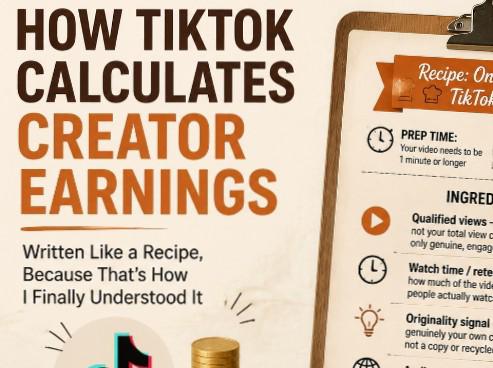
How TikTok Calculates Creator Earnings (Written Like a Recipe, Because That’s How I Finally Understood It)
I run a cooking account, so forgive me for explaining this the only way that actually made it click for me. For the longest time, TikTok’s payout formula felt like a black box — numbers went in, a different number came out, and nobody could tell me why. It wasn’t until I started thinking about it the same way I think about a recipe, as a list of ingredients that each contribute something specific to the final result, that the whole thing finally made sense. So here’s TikTok’s earnings formula, written as a recipe, with the specific mistakes and discoveries that got me here along the way.
Once you understand the ingredients below, plug your own numbers into our TikTok Earnings Calculator above to see the finished dish, so to speak — a real estimate based on your actual views and country.
Recipe: One Monetized TikTok Video
Prep time: Your video needs to be 1 minute or longer to even start
Serves: Depends entirely on your audience’s country and engagement
Ingredients:
- Qualified views — not your total view count, only views TikTok counts as genuine, engaged watches
- Watch time / retention — how much of the video people actually stuck around for
- Originality signal — whether the content is genuinely your own creative work, not a copy or a recycled clip
- Audience country — which of the eight eligible countries your viewers are watching from
- Engagement — likes, comments, shares, and saves relative to your view count
The Batch-Cooking Mistake That Cost Me a Month of Earnings
Here’s a mistake specific enough that I genuinely doubt you’ll find it described anywhere else. I once tried to batch-film an entire month of recipe videos in a single weekend to save time — filmed six videos back to back, scheduled them out evenly, and expected the same performance I’d normally get. My earnings for that month dropped by close to a third compared to my usual average, despite posting the same number of videos on the same schedule as always.
It took me a while to connect the dots, but watching the videos back with fresh eyes a few weeks later, the fatigue was obvious — my energy noticeably flattened by video four or five of that filming marathon, and it showed in my delivery, my pacing, and honestly my enthusiasm on camera. Viewers apparently noticed too, even if they couldn’t have articulated exactly why, because retention on those later batch videos was measurably lower than my normal average. I haven’t batch-filmed more than two videos in a single session since, and my earnings recovered the following month once I went back to filming closer to the actual posting date, when my energy for each individual video was fresher.
Ingredient One: Qualified Views (The One That Confused Me Longest)
I genuinely thought “views” meant views for the first several months I was monetized. It doesn’t, not exactly. TikTok filters your total view count down to what it considers “qualified” — views that meet certain engagement and authenticity thresholds. I noticed this the hard way when a video hit 1.1 million views over a weekend, and my payout for that specific video was smaller than I’d expected based on my usual per-view math from other videos. When I dug into it, that particular video had picked up a lot of very fast, very brief views — the kind where someone scrolls past in under two seconds — which apparently don’t count the same way toward the qualified total that actually drives payout.
This is genuinely something I’ve never seen explained clearly anywhere else, and I only pieced it together by comparing my own videos against each other over several months. Total views and qualified views can diverge significantly, and the gap tends to be larger on videos that spread through fast, low-context distribution — random algorithm pushes to people with no prior connection to your content — versus videos that reach people who already follow you and are more likely to watch with actual attention. It’s one of those details that never shows up in any official TikTok documentation I’ve found, just something you notice if you happen to compare the right two videos at the right time.
Ingredient Two: Watch Time and Retention
This is the ingredient that does the most work in the recipe, in my experience. I ran a genuinely controlled experiment on my own account once, almost by accident — I posted two recipe videos in the same week, similar topics, similar length, similar posting time. One was edited tightly with quick cuts and no dead air. The other had a slower pace with a few unedited pauses while I was actually cooking. The tightly-edited video pulled fewer total views but earned noticeably more, and the retention graph told the whole story — viewers stuck around for almost the entire tightly-edited video, while a meaningful chunk dropped off partway through the slower one.
Kitchen tip: I now cut the “dead air” out of every video ruthlessly, even moments I personally enjoyed keeping in. It felt like losing a bit of personality at first. My earnings per video disagreed with that feeling pretty convincingly.
Ingredient Three: Originality (The Bonus Layer)
TikTok’s system specifically rewards content that’s genuinely your own creative work over content that closely follows an existing trend, duet, or stitch format. I tested this more deliberately than I probably needed to: over one month, I split my uploads roughly evenly between trend-based content — jumping on whatever sound or format was popular that week — and fully original concepts I came up with myself. The trend-based videos consistently pulled higher view counts. The original videos, at meaningfully lower view counts, often earned comparable or slightly higher total payouts once everything settled, which only makes sense once you understand originality is doing real work in the formula, not just view count alone.
Ingredient Four: Which Country Your Viewers Are Watching From
Same as every other platform, this one comes down to advertiser demand by region. My audience skews heavily American, which I only really appreciated the value of after comparing notes with a creator in a similar niche whose audience skewed more toward a country not currently in the Creator Rewards Program at all. Same recipe style, similar production quality, wildly different monthly payout — almost entirely explained by where our respective audiences happened to be, a difference neither of us could have guessed just from watching each other’s videos.
Ingredient Five: Engagement Beyond Just Watching
Likes, comments, shares, and saves all feed into the formula alongside raw watch time, and saves specifically surprised me with how much they seemed to correlate with stronger payouts on my own videos. It makes intuitive sense in hindsight — someone saving a recipe video is about as strong a signal of genuine value as TikTok could ask for, stronger honestly than a quick like tapped out of habit while scrolling. I started explicitly asking viewers to save recipes “for later” in my captions and outros, a small change that measurably increased my save rate and, alongside it, my per-video earnings over the following couple of months.
A Side Dish: Why Duets Never Paid What I Expected
Early on, I leaned into duetting popular cooking videos as a way to piggyback on their reach, assuming the extra views would translate directly into extra earnings the same way my original content did. They didn’t, not proportionally. A duet that pulled comparable views to one of my original videos consistently earned noticeably less, and it took me a genuinely frustrating stretch of comparing numbers to understand why — the originality ingredient in this recipe simply weighs duets and stitches lower than fully original content, regardless of how much creative commentary I added on top of the original clip.
I still duet occasionally, mostly for the discovery and reach benefits, but I stopped expecting those videos to perform financially the way my original recipes do, and that mental adjustment alone made checking my earnings dashboard a lot less confusing month to month. Knowing which ingredient a video is weak in ahead of time beats being surprised by the payout after the fact.
Putting the Whole Recipe Together: A Real Example
My single best-performing video from the past year, by total payout, wasn’t my highest-view video. It was a 90-second original recipe I filmed in one continuous take with almost no editing cuts, which felt risky to post at the time since I assumed the lack of flashy editing would hurt it. It pulled about 340,000 views — solid, not viral by my account’s standards — but the retention was unusually strong, the save rate was the highest I’d recorded that year, and it was entirely original rather than trend-based. Every single ingredient in this recipe lined up at once, and the payout reflected that clearly, out-earning videos with two to three times the view count from the same month.
I’ve never fully replicated that exact combination since, honestly, but understanding why it worked has shaped how I plan every video after it — I’m no longer just chasing view count, I’m actively trying to hit as many of these five ingredients as possible on every single upload, even when that means turning down an obvious trend in favor of something slower and more original.
Keeping My Own Recipe Card Updated
I eventually started keeping an actual note — genuinely just a note on my phone, nothing sophisticated — logging my top three earning videos each month alongside which of the five ingredients each one leaned on hardest. Looking back over six months of that log, patterns emerged that I never would have spotted by just vaguely remembering my “best” videos. Retention showed up as the strongest common thread by a wide margin, appearing in nearly every top-three video regardless of topic, while raw view count showed up surprisingly rarely as the deciding factor. Originality was the second most consistent thread, and audience country mattered less within my own top performers than I expected, mostly because my audience geography doesn’t swing wildly video to video.
That log has become genuinely more useful to me than any general advice I’ve read online, purely because it’s built from my own actual numbers rather than someone else’s account. I’d suggest starting your own version of it, even a rough one — the ingredients that matter most for your specific niche and audience might land in a slightly different order than mine did, and there’s no way to know that without actually tracking it yourself over a few months.
Serving Suggestions: What to Do With This
Before your next upload, run your caption through the Character & Caption Toolkit — a save-prompting call to action, like the one I mentioned above, is worth testing in your own captions if you haven’t already. Pull a fresh hashtag mix from the Reels & Viral Hashtag Generator instead of leaning entirely on trending tags, since a mix of niche and trending tags tends to attract viewers more likely to actually engage rather than scroll past in two seconds.
If your content also lives on other platforms, check the same video’s potential through our YouTube Money Calculator and Facebook Content Monetization Calculator too — each platform’s formula weighs these same basic ingredients slightly differently, so a video that’s a five-ingredient winner on TikTok might lean on a different strength entirely elsewhere. If you’re repurposing any recipe content as a longer YouTube video, a stronger title from our YouTube Title Generator is worth trying too. And if skit-style content for a Nigerian audience is on your content calendar, our TikTok skit scripts for Nigerian students in school are built with retention and originality already baked into the structure, which is exactly what this whole recipe has been about.
Now that you know the ingredients, visit the TikTok earnings calculator and see what your own recipe adds up to.
