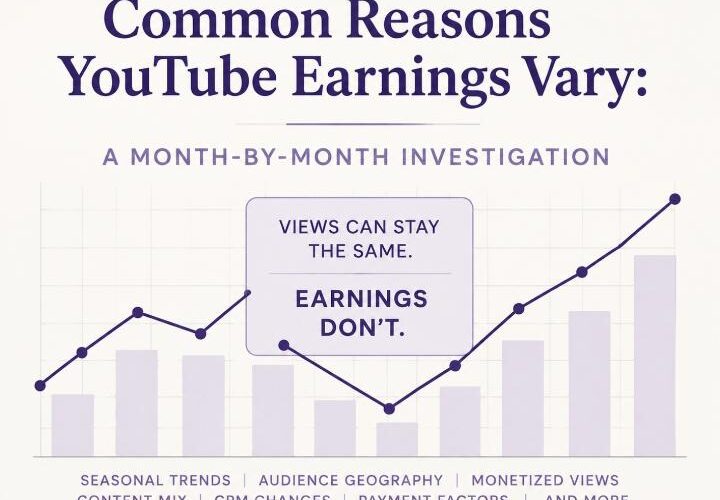
Common Reasons YouTube Earnings Vary: A Month-by-Month Investigation
Last February, I opened my AdSense dashboard and felt genuinely confused. My views for the month were almost identical to December’s — barely a 2% difference. My earnings, though, had dropped by nearly 40%. I remember refreshing the page twice, convinced it was a display bug, before slowly accepting that the numbers were correct and I simply didn’t understand why.
What followed was about three weeks of genuine detective work — comparing analytics month over month, reading through YouTube’s creator documentation more carefully than I ever had before, and messaging a few other creators to compare notes. This article is that investigation, written up as the case-by-case breakdown I wish someone had handed me back in February instead of making me piece it together myself.
If you’re currently staring at a confusing number of your own, run your current views through our YouTube Money Calculator above alongside last month’s — sometimes seeing both estimates side by side makes a pattern jump out that’s harder to spot buried in a dashboard.
Suspect #1: The Calendar Itself
This turned out to be the biggest culprit in my own February mystery, and it’s the most common explanation across every creator I compared notes with. Advertiser demand isn’t constant throughout the year — it spikes hard in the fourth quarter as brands rush to spend their annual budgets before the holidays, then drops noticeably every January and February as those same budgets reset to zero. My December RPM had been quietly inflated by seasonal demand the whole time, and I’d never noticed because I’d never had a full year of data to compare it against before. February wasn’t broken. December had been unusually generous.
Suspect #2: A Quiet Shift in Audience Geography
One creator I spoke with during my investigation had a completely different story, and it took her much longer to solve than mine took me. Her views held steady for nearly four months while her earnings slowly, almost imperceptibly, declined. She eventually checked her Audience tab in YouTube Studio and found that a video which had unexpectedly picked up traction in a lower-CPM region was now making up a meaningfully larger share of her total monthly views than it had before, quietly dragging her blended average RPM downward. Nothing was “wrong” — her content had simply found a new pocket of viewers, and that pocket happened to be worth less per view than her usual audience.
Suspect #3: Not Every View Gets Monetized
This is the one that surprised me most once I actually understood it properly. Total views and monetized views are two different numbers, and the gap between them is usually bigger than creators assume. Ad blockers, viewers in regions with limited advertiser coverage, and videos flagged for limited ads all shrink the pool of views actually generating revenue — sometimes by a meaningful percentage of your total. I’d been treating my total view count as if every single view was equally “worth” something, which was never actually true.
Suspect #4: A Viral Video That Wasn’t Actually Retained
A gaming creator I follow had a video unexpectedly explode to nearly 2 million views in a single week — the kind of spike every creator dreams about. His monthly earnings barely moved. When he dug into the analytics, average view duration on that specific video was under 90 seconds out of an 11-minute upload, meaning the vast majority of that massive view count never stuck around long enough for more than a single ad impression, if that. A quieter, less flashy video from the same month, with a fraction of the views but far stronger retention, actually out-earned the viral one by a wide margin. Viral reach and viral revenue are not automatically the same thing, and this was the clearest example of that gap I’d personally seen. He told me afterward it was almost a relief to understand why, since he’d spent the first week of the spike convinced something was broken with his AdSense account rather than understanding it was simply a retention issue on one unusually large outlier video.
Suspect #5: Payment Thresholds and Currency Conversion
This one isn’t about your earnings actually changing at all, just about when and how you see them. AdSense only issues payment once your balance crosses a minimum threshold, so a lower-earning month sitting just under that line can make it look like a “bad month” in your bank account, when your actual channel performance was perfectly normal — the payout simply rolled into the following month instead. For creators paid in a currency different from what YouTube reports in, exchange rate fluctuations between the reporting date and the payout date can also shift the final number slightly, in either direction, without anything about the channel itself changing.
Almost every “mysterious” earnings drop I’ve investigated — my own or someone else’s — turned out to have a completely mundane explanation. The mystery is usually just a gap in understanding, not an actual problem.
Suspect #6: A Change in Your Own Content Mix
A cooking creator I compared notes with during this investigation had quietly shifted her upload mix over a few months without really noticing — more quick 3-minute recipe videos, fewer of her longer 10-to-12-minute deep dives. Her total views actually climbed slightly during that stretch, but her earnings dropped by close to a quarter. Shorter videos simply carry fewer mid-roll ad opportunities, and the shift had been gradual enough that she hadn’t consciously registered it as a strategic decision — it had just sort of happened, video by video, as shorter content felt easier to produce week to week. Once she noticed the pattern and deliberately reintroduced more long-form content into her schedule, her RPM climbed back within about six weeks.
Suspect #7: Broader Advertiser Market Conditions
This is the suspect that’s hardest to investigate yourself, because it has nothing to do with your channel at all. Broader economic conditions affect how aggressively advertisers bid across the entire platform — during periods of economic uncertainty, ad budgets across many industries tighten, which shows up as a lower average CPM across YouTube as a whole, not just for your specific channel. I only identified this one by comparing notes with several other creators across completely different niches, all of whom noticed a similar dip during the same few-month window despite having nothing else in common. If your earnings dip lines up with a period where several unrelated creators are reporting the same thing, this is likely at least part of the explanation, and it’s genuinely outside anyone’s individual control.
The One Time It Actually Was a Real Problem
I want to be fair here, because not every drop is explained by the five suspects above. A friend’s tech channel saw earnings crash by more than 70% in a single month with no corresponding view drop, and this time it genuinely was something worth worrying about — one of his videos had been flagged for a copyright claim on background music he’d licensed but hadn’t properly documented, and the claim redirected a portion of that video’s ad revenue to the claimant instead of him. Once he sorted out the licensing paperwork and disputed the claim successfully, revenue on that video was restored, though it took about three weeks to resolve.
The honest way to tell the difference: check your Content Manager and Copyright tab in YouTube Studio for any active claims before assuming your drop is just seasonal or geographic. If a claim is present, that’s usually the real explanation, and it’s worth addressing directly rather than waiting it out.
A Simple Checklist for Your Own Investigation
Next time your numbers look off, work through these in order rather than panicking immediately. First, check the calendar — is it January, February, or shortly after a major holiday, when ad demand is seasonally low across the entire platform? Second, check your Audience tab for any meaningful shift in your top countries by watch time. Third, check whether a single low-retention viral video is skewing your view count without contributing proportional revenue. Fourth, check your Copyright and Content Manager tabs for any active claims. Fifth, take an honest look at your recent upload mix — has your average video length quietly drifted shorter or longer than usual? Only after ruling out all five is it worth assuming something is genuinely, uniquely wrong with your channel.
In my experience, and in every case I compared notes on while writing this, at least one of these five explains the vast majority of “why did my earnings suddenly change” moments. Genuinely unexplainable drops are rare — most of the time, the explanation is sitting in a tab of YouTube Studio you just haven’t checked yet.
Why Tracking Monthly Numbers Matters More Than Any Single Month
The real fix for the confusion I felt that February wasn’t solving the mystery once — it was starting to track my numbers monthly going forward, so the next dip came with immediate context instead of panic. I now keep a simple running note of my monthly views, monthly estimated earnings from the calculator, and my top audience country, checked at the start of each month. Looking back at even six months of that log makes seasonal patterns and audience shifts obvious in a way that a single confusing month never can on its own.
If your content spans multiple platforms, this same investigative habit applies there too — a dip on YouTube doesn’t necessarily mean a dip everywhere. Cross-check your numbers with our TikTok Earnings Calculator and Facebook Content Monetization Calculator before assuming a platform-wide problem when it might just be a YouTube-specific seasonal dip.
Why Comparing Notes With Other Creators Helped More Than Solo Research
I want to be honest that I didn’t solve my own February mystery entirely alone. Reading YouTube’s help documentation got me part of the way there, but the piece that actually clicked was messaging three other creators in different niches and simply asking what their February had looked like. Two of them had seen a similar, unexplained-feeling dip. One hadn’t noticed anything unusual at all, which turned out to be because her audience skewed toward a region where the seasonal ad-demand dip is less pronounced. That single conversation did more to confirm the seasonal explanation than any amount of solo research had managed on its own.
If you’re stuck on a confusing month of your own, this is genuinely one of the most underused tools available to you. Creator communities, whether that’s a Discord server, a subreddit for your niche, or just a handful of other creators you already know, tend to be far faster at pattern-matching a shared explanation than any single person digging through their own dashboard in isolation. A dip that looks mysterious in your own numbers alone often looks completely obvious the moment you realize five other unrelated creators are seeing the exact same thing at the exact same time.
Closing the Case
My own February mystery, in the end, was almost entirely explained by suspect #1 — seasonal ad demand — with a small contribution from suspect #3, since I’d also picked up a bit more international viewership that month than usual. Nothing was broken. I just hadn’t lived through a full calendar year of data yet, and I didn’t understand the system well enough to see the pattern coming.
If there’s one thing I’d want a newer creator to take from this whole investigation, it’s that confusion about your own numbers is completely normal and doesn’t mean you’re doing anything wrong. Every experienced creator I know has their own version of my February story — a month that looked alarming until they actually understood what was happening underneath it. The panic fades fast once you know where to look.
Before your next upload, a sharper title from our YouTube Title Generator can help you build the kind of consistent, retention-focused content that makes month-to-month swings easier to read correctly. And if skit-style content for a Nigerian audience is part of your strategy, our TikTok skit scripts for Nigerian students in school are a solid place to keep building a consistent library worth tracking over time.
Confused about a number this month? Work through the five suspects above before you panic — odds are good the answer is more boring, and more fixable, than it feels right now.
