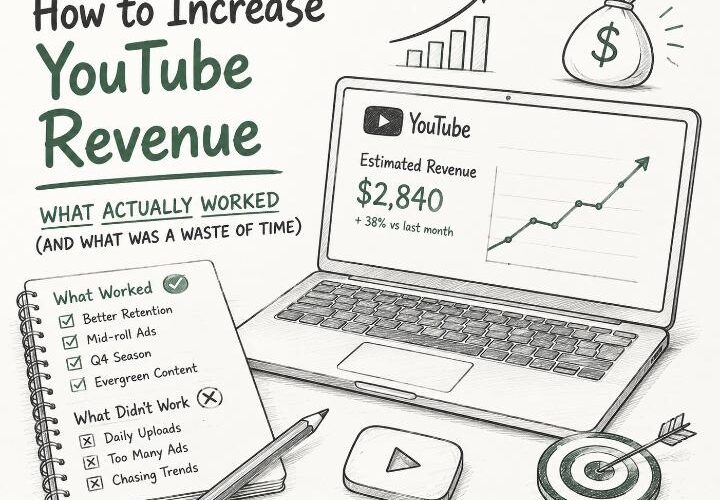
How to Increase YouTube Revenue: What Actually Worked (and What Was a Waste of Time)
Three years ago I made a spreadsheet — an actual, embarrassing spreadsheet — listing every single “grow your YouTube income” tip I could find across forums, videos, and blog posts. Forty-one items. I tried to do all forty-one at once, which is exactly as chaotic as it sounds, and after two exhausting months my revenue had barely moved. What finally worked wasn’t doing more things. It was figuring out which handful of things actually mattered and dropping the rest entirely.
This article is the short version of that spreadsheet — the things that genuinely moved my numbers, told honestly, including the parts that didn’t work and cost me time I won’t get back.
Before diving in, it’s worth knowing your current baseline. Run your monthly views and country through our YouTube Money Calculator above so you have a real number to measure improvement against — vague progress is hard to feel motivated by, but a concrete number climbing month over month is genuinely satisfying to watch.
✅ What Actually Worked
1. Fixing retention on my first 30 seconds
This was the single biggest lever, and it wasn’t close. I used to open videos with a slow, rambling intro — thanking people for watching, explaining what the channel was about, easing into the topic. My audience retention graph showed a brutal drop in the first 20 seconds on almost every video. I rewrote my intros to state the actual promise of the video in the first sentence, cut the rambling entirely, and my average view duration climbed by nearly 40% within a month. Longer watch time meant more ad slots could actually play, which directly increased my RPM.
2. Deliberately making videos long enough for multiple mid-rolls
I used to cut videos short out of a vague worry that longer content would bore people. Once I started planning content structure to naturally support two or three well-placed mid-roll ads — without padding for the sake of padding — my per-video revenue increased noticeably, even on videos with similar view counts to my shorter ones.
3. Leaning into Q4 instead of taking a break
I used to slow down uploads around the holidays, assuming everyone was too busy to watch. It turns out advertiser demand spikes hard in October through December as brands spend down annual budgets, which means the same video posted in November can out-earn an identical video posted in February. Now I deliberately batch extra content ahead of Q4 instead of coasting through it.
4. Building one genuinely evergreen video series
Trend-chasing videos spike hard and die fast. I started one series built around genuinely timeless questions in my niche — the kind people search for year-round regardless of news cycles — and those videos now quietly bring in a steady, compounding trickle of views and revenue more than a year after publishing, long after any trend-based video from that same period stopped earning anything meaningful.
❌ What Wasted My Time
1. Posting daily out of pure volume panic
For about five weeks I posted a video every single day, convinced volume alone would fix everything. Quality dropped noticeably, my retention per video fell, and my overall channel RPM actually declined during that stretch despite more total uploads. I went back to three well-made videos a week and both my retention and my revenue recovered within a month.
2. Maxing out mid-roll ad frequency
More ads per video sounds like more money, and briefly it was — until viewers started noticeably dropping off mid-video, annoyed by the interruption frequency. My total watch time fell enough that my overall revenue per video actually went down despite more ad slots technically running. I dialed back to a more reasonable spacing and revenue recovered.
3. Chasing every trending topic in my niche
Trend videos brought in short bursts of views but almost no lasting revenue, and the constant scramble to stay current burned a huge amount of production time relative to what I earned back. My evergreen series, made with a fraction of the weekly effort, now consistently out-earns what any single trend video ever did over its full lifetime.
A Message From a Reader Who Tried This
A few months after I first wrote about my retention fix publicly, someone running a cooking channel messaged me with their own version of the same story. They’d been opening every video with a 45-second intro showing their kitchen setup and greeting viewers by name from the comments — friendly, but slow. Their retention graph showed almost half their audience gone before the actual recipe even started. They cut the intro down to eight seconds, opened instead with the finished dish and a one-line promise of what viewers would learn, and moved the personal greeting to the end of the video instead.
Within six weeks, their average view duration had climbed by roughly a third, and their monthly ad revenue had increased by close to 50% on a very similar view count to before. Nothing else about their content changed — same recipes, same presenter, same upload schedule. Just the first eight seconds. It’s one of my favorite examples of how much leverage sits in the part of a video most creators think about least.
Thumbnails: The Lever Nobody Wants to Work On
I’ll be honest about this one: for the first year of my channel, I treated thumbnails as an afterthought, something I threw together in two minutes right before hitting publish. It’s the least fun part of making a video for a lot of creators, myself included, and it shows in how often it gets rushed. But your thumbnail and title work together as the actual gate every single view has to pass through — no matter how strong your retention or ad placement strategy is, none of it matters for a video nobody clicks on in the first place.
The fix that worked for me wasn’t hiring a designer or learning complex design software. It was simply spending fifteen extra minutes per video testing two or three thumbnail concepts against each other using YouTube’s built-in comparison tools where available, and picking based on actual click data rather than my own gut feeling about which one “looked best.” My gut feeling was wrong more often than I expected. That fifteen minutes, multiplied across every upload, added up to a genuinely meaningful click-through rate improvement over a few months — and every additional click is a chance at additional ad revenue that a weaker thumbnail would have quietly lost.
The Mistake That Actually Taught Me the Most
Here’s the honest, slightly embarrassing story behind all of this. About a year and a half into my channel, I got obsessed with a single metric — total monthly views — because it was the number that felt most satisfying to watch climb. I optimized everything around it: shorter videos, punchier hooks, more frequent uploads, trend-chasing. Views did climb, steadily, for months. My actual monthly revenue barely moved the entire time, and for a while I genuinely couldn’t understand why.
The answer, once I actually sat down and compared my analytics properly instead of just watching the views counter, was that I’d been optimizing for a vanity metric instead of a revenue metric. Shorter, punchier videos meant fewer mid-roll ad opportunities per video. More frequent uploads meant less time invested in retention-focused editing per video. Trend content meant a burst of views that evaporated within days instead of the slow, compounding traffic evergreen content builds. Every choice that pumped up my views number was quietly working against my revenue number.
I spent a year chasing a number that felt good to watch instead of the number that actually paid my rent. They looked related. They weren’t the same thing at all.
Once I switched my north-star metric from total views to estimated monthly revenue — checking the calculator regularly instead of just my view counter — my content decisions changed noticeably, and my actual income followed within a couple of months.
How Long Before You Actually See a Difference
One thing nobody told me early on: none of these changes show up instantly. Retention improvements typically need several videos and a few weeks before YouTube’s recommendation system fully adjusts to the new pattern and starts reflecting it in your actual numbers. Thumbnail and title improvements can show a faster click-through signal, sometimes within days, but the downstream revenue effect still takes a few weeks to fully compound as more of your catalog benefits from the pattern.
The honest timeline, based on my own channel and the handful of other creators who’ve shared their experience with me, is somewhere between four and eight weeks before a genuine, consistent shift shows up in your monthly revenue number rather than just a single lucky video. That’s not a long time in the grand scheme of running a channel, but it’s long enough that a lot of creators give up on a change after a week or two of not seeing results, right before it would have actually kicked in. Give any single change here at least a month of consistent application before deciding whether it worked.
Diversifying Beyond Ad Revenue Entirely
The single biggest jump in my total monthly income, bigger than any ad-revenue optimization on this list, came from stepping outside ad revenue entirely. Once my channel had a genuine, engaged audience, sponsorships alone eventually outpaced my ad revenue most months — a single well-matched sponsor often paid more for one video than an entire month of ads did. Digital products, priced honestly for what my audience could actually afford, added a second steady stream on top of that.
If your content also lives on other platforms, this same diversification logic applies there too. Check what your video content earns through TikTok’s Creator Rewards and Facebook’s Content Monetization program — for a lot of creators, one of those platforms quietly ends up outperforming YouTube ad revenue once you actually run the numbers side by side instead of assuming.
A Simple Monthly Habit Worth Building
Once a month, I now spend fifteen minutes doing three things: checking my top five videos by revenue rather than by views, checking my audience retention graph for any videos with an unusually sharp early drop-off, and rerunning my numbers through the calculator with my current view average. That fifteen-minute habit has taught me more about what actually grows my income than any single tip from that forty-one-item spreadsheet ever did.
I keep a simple running log now too — nothing fancy, just a note with the date, my monthly view count, and my monthly revenue estimate, updated at the start of each month. Looking back at eighteen months of that log side by side is far more motivating than any single month ever felt in the moment, because it makes the slow, unglamorous progress visible in a way that day-to-day checking never quite captures. The month I fixed my intro looks unremarkable in isolation. Looking at it against the twelve months before it, it’s obviously the turning point.
Before your next upload, it’s also worth running your title through our YouTube Title Generator — a stronger, better-scored title feeds directly into the retention and revenue habits above, since none of it matters if the video doesn’t earn the click in the first place. And if skit-style content for a Nigerian audience is part of your content mix, our TikTok skit scripts for Nigerian students in school are built with exactly this kind of retention-first structure in mind.
Looking back at that forty-one-item spreadsheet now, I keep it around mostly as a reminder of how much time gets wasted trying to do everything at once instead of doing the right four or five things consistently. If there’s one thing worth taking from this whole article, it’s that: fewer changes, applied properly and given enough time to actually work, beat a long list applied half-heartedly every single time.
Pick two things from the “What Actually Worked” list above, ignore the rest for now, and check your revenue again in a month. That’s how real progress actually looks — slow, then suddenly obvious once you look back at where you started.
