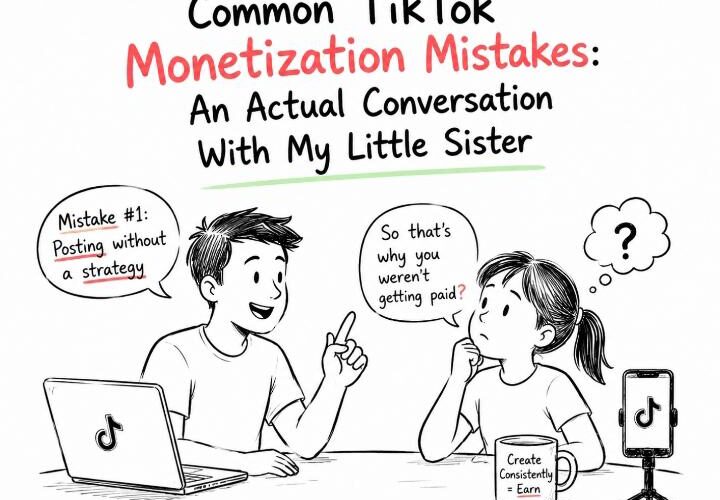
Common TikTok Monetization Mistakes: An Actual Conversation With My Little Sister
My younger sister started a TikTok six months ago and asked if she could sit down with me and just ask questions — no script, no prep, whatever came to mind. I recorded the audio to transcribe later for my own notes, and reading it back, it’s genuinely a better breakdown of common mistakes than anything I could have written top-down, because her questions came from real confusion, not a content outline. Here’s the transcript, lightly cleaned up, with a bit more explanation added after each exchange for anyone reading who wasn’t in the room to ask a follow-up question themselves, since not everyone has an older sibling who’s already made every possible mistake.
Before we get into it, check your own numbers against our TikTok Earnings Calculator above — a few of the mistakes below only become obvious once you’re actually looking at a real estimate instead of guessing blind the way she was.
HER:
“Okay so I’ve posted like 40 videos and I have basically nothing to show for it. What am I doing wrong?”
ME:
Honestly, first question — how many of those 40 are over a minute long? Because Creator Rewards only pays on videos over 1 minute, and if most of yours are 20-30 second clips, that’s mistake number one right there. It’s not that they’re bad videos, they’re just not eligible for the program at all.
HER:
…oh. Yeah, maybe five of them are over a minute. I didn’t know that was a rule.
Mistake #1: Posting Under a Minute and Expecting Creator Rewards Anyway
This is genuinely the most common mistake I see, and it’s an easy one to make because nothing in the app actively stops you from posting a 20-second video or tells you it won’t qualify. It just quietly doesn’t count. My sister isn’t alone in not knowing this — I made the exact same mistake for my first two months, wondering why my earnings weren’t budging despite consistent posting, before I actually read the fine print on eligibility requirements properly.
HER:
“Okay so should I just make everything over a minute now?”
ME:
Not blindly, no — that’s the second mistake waiting to happen. Padding a video to hit a minute when it only needed 35 seconds of actual content is worse than posting it shorter, because the extra dead air kills your retention, and retention matters more to your actual earnings than just crossing the length threshold.
HER:
so it’s not just “make it longer,” it’s “make it long enough for a good reason.” got it.
Mistake #2: Padding Length Instead of Earning It Naturally
I’ve watched creators, including a version of myself early on, stretch a video with slow intros, unnecessary pauses, or repeated points just to clear the 1-minute mark. It backfires almost every time, because TikTok’s system weighs watch time and retention heavily, and a padded video with a sharp drop-off partway through performs worse in the formula than a tight video that happens to naturally run 65 seconds because the content actually needed that long.
HER:
“Okay next question — I’ve been duetting a lot of popular videos in my niche because I figured that would help me get seen faster. Bad idea?”
ME:
Not a bad idea for growth, actually — duets can genuinely help with discovery. But if you’re relying on them for earnings specifically, that’s mistake three. TikTok’s system weighs original content more heavily than duets and stitches when it comes to the actual payout, so a duet with a lot of views often earns noticeably less than an original video with fewer views.
HER:
that explains a lot honestly. my duets get way more views than my original stuff but I never really compared what they actually earned.
Mistake #3: Leaning on Duets and Stitches for Income, Not Just Growth
This is a distinction I wish someone had drawn clearly for me earlier: duets and stitches are genuinely useful growth tools, riding an existing video’s momentum to get your name in front of a new audience. They’re just weaker earning tools specifically, because the originality signal in TikTok’s payout formula treats them differently than fully original content. Use them, but don’t build your monetization strategy around them.
HER:
“Okay this one’s embarrassing but — I still don’t fully understand what ‘qualified views’ means. Every time I look it up it’s explained in this really vague corporate way.”
ME:
It’s not embarrassing, that phrase genuinely is explained badly everywhere. Basically: not every view counts equally. A view where someone watches two seconds and scrolls away doesn’t carry the same weight as a view where someone watches most or all of the video. If a huge chunk of your views come from people scrolling past almost instantly, your total view count can look decent while your actual qualified views — the number your earnings are really based on — stays much lower.
HER:
okay that actually makes sense now. I’ve been so focused on the view number at the top and never looked at retention at all.
Mistake #4: Watching the View Count and Ignoring Retention
This mistake is so common it’s almost universal among new creators, myself included at the start. The view count is the biggest, most visible number on your dashboard, so it’s naturally what everyone fixates on. But it’s genuinely one of the least useful numbers for understanding your actual earnings trajectory. Retention — how long people actually watch — predicts your payout far more reliably than raw views do, and it’s usually buried a tap or two deeper in your analytics, which is probably why so few new creators ever look at it until something forces them to, the way a confusing payout eventually forced me to.
HER:
“Last one — is there a mistake you made that you haven’t told me about yet? Like, worse than the ones we’ve talked about?”
ME:
Honestly yeah — for the first three months I was eligible, I never checked whether my country’s Creator Rewards status could even change month to month, and I just assumed eligibility was permanent once granted. I found out the hard way it isn’t automatically guaranteed forever if your account falls below the follower or engagement thresholds again — I had one rough month where my numbers dipped and I briefly lost eligibility without understanding why my payout suddenly stopped. Took me two confused weeks to figure out it was a temporary dip, not a permanent loss.
Mistake #5 (The One I Only Admitted to Her): Assuming Eligibility Is Permanent
This genuinely doesn’t get talked about enough. Creator Rewards eligibility isn’t a one-time gate you pass through and never think about again — it’s tied to ongoing metrics, and a significant dip in activity or engagement can temporarily affect your status. I found this out during a stretch where I was posting inconsistently due to travel, and my payout simply stopped one month with no clear explanation in the app. It took real digging through settings and support documentation to understand it was a temporary eligibility dip rather than a permanent account issue, and it resolved itself once I got back to consistent posting and my metrics recovered — though the two confused weeks in between were genuinely stressful, checking my dashboard daily convinced something was seriously wrong.
The lesson, which I passed on to her directly: treat consistency as part of maintaining eligibility, not just building it the first time. A long gap in posting can cost you more than just missed views — it can quietly affect your monetization status too, in a way the app doesn’t warn you about clearly before it happens, which is exactly the kind of gap this whole conversation was meant to fill.
HER:
“Wait, one more — I saw someone online say you have to post like 3-5 times a day to actually grow. Is that true? Because that sounds exhausting and I don’t think I can keep that up.”
ME:
That’s mistake number six, actually, and it’s one I fell into hard for about a month. Posting more doesn’t automatically mean earning more — if the quality drops because you’re rushing five videos out a day instead of making one or two genuinely good ones, your retention across the board suffers, and retention is what actually drives your earnings. I tried the 3-5-times-a-day thing myself once, burned out within three weeks, and my earnings per video actually dropped during that stretch compared to my normal, slower pace.
HER:
okay that’s genuinely a relief to hear. I was stressing about not having time for that.
Mistake #6: Chasing a Posting Frequency That Isn’t Sustainable
Every platform seems to have its own version of this myth, and TikTok’s version is especially persistent because the app’s fast-paced culture makes high-frequency posting feel like the obvious strategy. In my own experience, and in comparing notes with several other creators over the years, consistency at a sustainable pace — three or four genuinely well-made videos a week, say — tends to out-earn a frantic daily-multiple-posts schedule that quietly sacrifices quality for volume. The exhaustion alone tends to show up in your content before you consciously notice it happening, and viewers pick up on that flatness faster than creators usually expect, well before the creator themselves has connected the dots between burnout and a quietly shrinking payout.
HER:
“Okay, last thing — why did nobody tell me any of this before I started? Like, this stuff seems pretty important.”
ME:
Honestly? Because most of it isn’t written down anywhere clearly. TikTok’s official help pages explain the rules in the vaguest possible corporate language, and most creator advice online is either outdated, written by someone who’s never actually been monetized, or focused entirely on growth tips that have nothing to do with how the payout formula actually works. The stuff that actually matters mostly gets passed creator to creator, the way we’re doing right now.
Where the Conversation Ended Up
By the end of that conversation, she’d identified more of her own mistakes out loud than I could have listed for her upfront, which honestly is exactly why I think this format works better than a straightforward tips list. She went back and re-edited her posting plan that same night — longer videos where the content actually justified it, fewer duets relative to original content, and an actual habit of checking retention instead of just the top-line view count.
If you’re catching yourself in one or more of these six mistakes, you’re in genuinely good company — I made every single one of them myself at some point, and so has nearly every creator I’ve compared notes with since. The honest truth is that almost nobody figures this out from reading a guide beforehand; most of us learn it the same way she did, by asking someone who’s already made the mistakes and is willing to admit it out loud, which is exactly what this whole transcript has tried to be.
Fixing the Small Stuff Too
Alongside the five mistakes above, tightening your caption with the Character & Caption Toolkit and pulling a genuinely fresh hashtag mix from the Reels & Viral Hashtag Generator — rather than recycling the same five tags on everything, which I also had to point out to her — round out the basics most new creators skip early on, alongside everything above.
If your content also lives elsewhere, run the numbers through our YouTube Money Calculator and Facebook Content Monetization Calculator too, and if a longer version of your content works as a YouTube upload, our YouTube Title Generator is worth a try. She’s since started building comedic skit content too, and our TikTok skit scripts for Nigerian students in school became her actual starting point the following week.

So,I like it